

Rubens River: when fishing is part of living in the place
- Mauricio Kusanovic
- Feb 9
- 5 min read

A river that you learn by walking it, year after year.
Fishing on the Rubens River has been a part of my life for many years . It's not a river you "get to know" quickly; it's a river that reveals itself over time, with patience, with hours of wind in your face, and with many misinterpretations before you truly begin to understand it.

Today we are fortunate to have over 10 kilometers of river bordering the Cerro Negro Ranch , and that makes a huge difference. Not because it's an enclosed river, but because it allows something increasingly rare: access to the river itself .
The public access to the Rubens River is via the bridge . From there, anyone can fish. In other sections, the river flows through private land, so permission is required. And one of the concrete advantages of being within the Cerro Negro Ranch is precisely that: being able to reach stretches where fishing pressure is much lower , where the river flows more calmly, and the fish aren't constantly disturbed.
A River Born with in the Peat lands

The Rubens is not, in general, a river of crystal-clear water. It has moments of absolute clarity, yes, but its character is marked by its origin: it rises from a vast system of peat bogs.
We're talking about a wetland system that easily exceeds 20,000 hectares , and which functions as an extraordinary natural regulator. The peatland absorbs the water when it rains, expands, and then slowly releases it, like a living sponge. That's why the Rubens doesn't respond immediately to rainfall, like other rivers. It has memory. It has a delay. It has a pulse.
That doesn't mean it's a docile river. It can swell many times its size, and there are stories—my father told me—of enormous floods, of a Rubens very different from the one we see today. The river changes, it moves, it rewrites its course.
In winter, much of the Rubens River is hidden under ice. Estancia Cerro Negro sits at nearly 200 meters above sea level , in a higher and colder area than other parts of the region. Here, winter feels harsher: there is snow where there isn't elsewhere, and the river flows silently.
A river that demands respect
The Rubens is not a river to be taken lightly.

Fishing upstream is often difficult: the wind is almost always against you. Crossing it during high water requires real attention. Its structure is constantly changing: new bends, fallen trees, branches appearing where they weren't before.
It is not a static river.
It is not a river that is easily "memorable".
And that's precisely why, when you start to understand it, it becomes deeply addictive.
Pools, curves and living structure
It is a very winding river, with an extraordinary structure:
Well-defined pools
Large and small trees fallen
Shoreline cuts, branches, rocks
Beach areas and long wadeable stretches
All of that creates shelter. And where there's shelter, there are trout.

When the weather is right, sight fishing is incredible , especially with dry flies , which is undoubtedly my favorite way to fish on this river. The Rubens, being relatively small, forces you to be fully present: you see the fly, you see the fish, you understand the mistake or the success.
The streamer also plays a key role: black, with small touches of color , not too heavy. The river isn't deep, but it does have some very interesting pools. Nymphs work well at certain times—at the end of the day, a large part of the fish's diet is there—but the Rubens always invites you to look at the surface.
The Sea Run: The Rubens Grand Prix
One of the most anticipated moments of the year at the Rubens is the arrival of the sea run: the migratory brown trout.
These trout are born in the river , migrate downstream to the sea—in this case, the Atlantic —and, after one or more years feeding in a marine environment, return to the river to reproduce . They come back bigger, stronger, and more silvery.
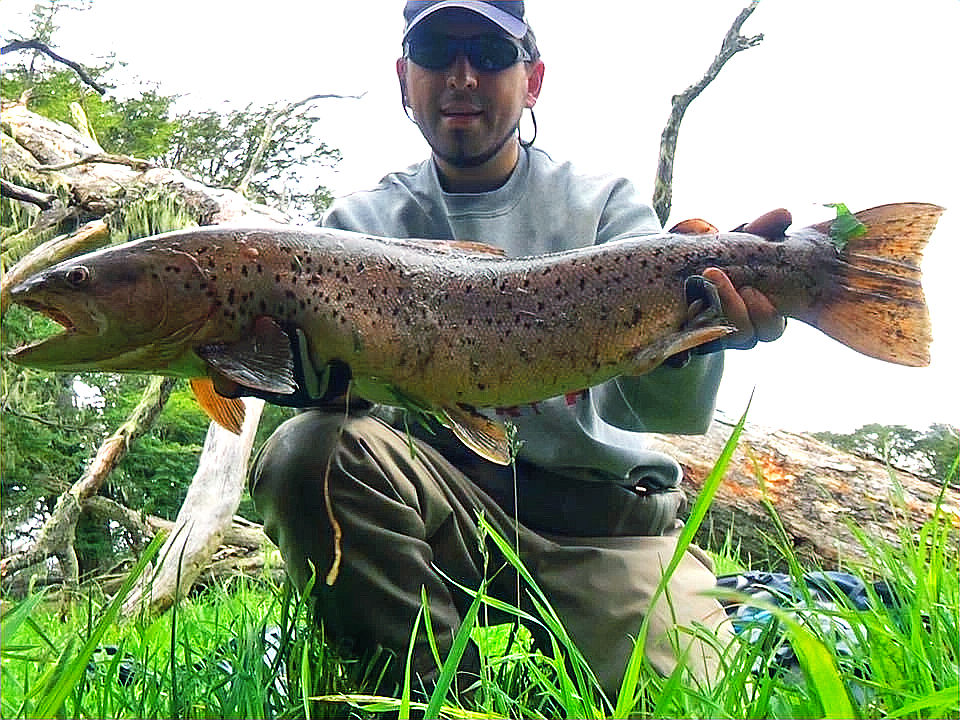
When the Sea Run enters the Rubens River, the river changes. Fish weighing 4, 5, or 6 kilos appear, and it's not uncommon to see specimens of 7 or 8 kilos . In fact, a 5-kilo Sea Run is quite normal at that time. They are different fish: wide-bodied, powerful, pure energy.
Its not the same every year. You don't see them every day. But when it does, the Rubens reminds us why it's a special river.
A river system and a mythical lagoon
The Rubens River does not exist in isolation. It is formed by the confluence of several important tributaries: the Blanco River , the Kerver River, the Hondo River , the Carbón River , among others.

Further upstream, about 10 kilometers from the confluence , lies a mythical lagoon , very difficult to access. Ancient tales tell of this lagoon: an abundance of fish, of unusual sizes, a place seemingly outside of time. It is not an easy place to reach, and perhaps that is precisely why it retains its pristine mystique.
Furthermore, the river holds the memory of its former courses. There are sections where the Rubens once flowed and then changed course, leaving isolated pools in the peat , small ecosystems with fish that remained there. When you discover them, fishing for them is a completely different, almost secret, experience.
The river from the water
A few years ago I discovered another way to understand the Rubens: going down it in a small boat or cataraft, without a motor.
The river isn't fast-flowing, allowing you to descend calmly, casting short towards snags and structures, trying again and again. Fishing this way is incredibly effective, but above all, it's a different experience : silence, rhythm, and a constant reading of the water.

It allows you to stop wherever you want, fish a complete bend, and continue. It gives you access to places that are almost impossible to reach on foot. It's a very honest and respectful way to experience the river.
More than fishing
The Rubens doesn't always deliver. But it always gives something back.
Fishing here is not just about catching fish. It's about understanding a living system, a river born from peatland, shaped by time, ice, and wind.
And living near it—with real, everyday access—is not a superficial luxury. It's a different way of inhabiting the territory.
For some, the Rubens River is an occasional destination. For others, a challenge. And for those of us who live here, it's part of the landscape, the routine, and the history.
Visit http://www.lifeinpatagonia.com For more information about the projects and how to co-inhabit Patagonia.


Comments